An automated audit, with an auto-generated report you can actually hand over.
Three engines run over your contract — static AST detectors, Slither, and an AI review of the business logic — and the findings are rendered straight into a graphical PDF. No queue, no scheduling call, no analyst writing it up next week.
The pipeline, pass by pass
"Automated" covers everything from a regex over a source file to a serious analysis stack. It is worth knowing which one you are buying, so here is the whole thing in order.
Source resolution
A verified address plus a chain is enough — the flattened source and the exact compiler settings come from the explorer, and if the address is a proxy the implementation is resolved and audited alongside it. Compiler version is read, never assumed, because several findings depend on it: unprotected arithmetic is a real bug on 0.7 and noise on 0.8.
Static analysis over the AST
The source is parsed and walked by twenty detector classes. Working on the syntax tree rather than on text is what makes this reliable — it distinguishes a state write from a comment mentioning one, and it sees a call inside a modifier inside an inherited contract. Deterministic, fast, and nothing is executed.
Slither
On the top tier, Slither runs as an independent second opinion and its findings are merged with ours. Independent engines agreeing raises confidence; disagreement is itself a flag worth a human glance.
AI deep analysis
The pass that addresses the classic weakness of automation. Pattern matchers cannot tell that a fee setter can reach 100%, that a reward loop credits before it debits, or that a pause has no unpause. The AI reads for business-logic traps, tokenomics abuse and honeypot patterns, and the output is cross-checked against the static findings so nothing is reported twice under two names.
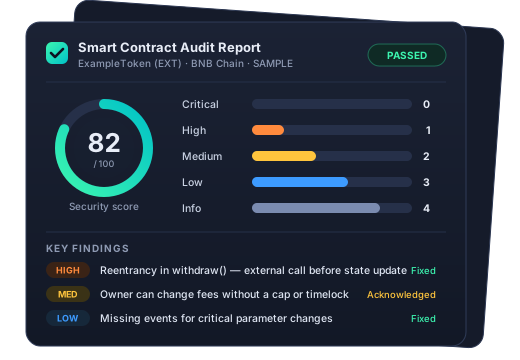
Auto report: smart contract audit findings, rendered
Findings are scored, ranked by severity and confidence, mapped to their SWC and OWASP entries, and rendered into the PDF: risk gauge, severity breakdown, coverage grid, then one entry per finding with the highlighted code, an attack-path diagram and remediation.
What automation is good at, and what it is not
Any vendor who will not draw this line is not worth buying from, so here it is drawn.
| Question | Automated | Human expert |
|---|---|---|
| Known vulnerability classes | Complete and deterministic | Reliable, but fallible and slower |
| Standards coverage (SWC / OWASP) | Exhaustive by construction | Usually sampled |
| Centralization and owner powers | Enumerated mechanically | Also judged in context |
| Gas inefficiency | Systematic | Often out of scope |
| Novel economic attacks | No | This is the job |
| Cross-protocol composability risk | No | Yes |
| Does the code match the whitepaper? | No | Yes |
| Turnaround | Minutes | 1–4 weeks, booked ahead |
The two columns are complements, not competitors. Everything in the top half is work a human should never be billed for; everything in the bottom half is work no tool can do. The audit companies page covers how to combine them.
Automation's real advantage: repetition
The speed is the obvious benefit, but the durable one is that an automated audit is cheap enough to run again. A manual audit is a snapshot of one commit; the moment you fix a finding, the audited code and the deployed code diverge. Teams live with this because re-engaging a firm costs thousands.
An audit you can afford to re-run after every change is worth more, over a project's life, than a deeper audit you run once and then invalidate with your next commit.
Run it on every meaningful change, before each deployment, and on testnets for free while you iterate. Reports stay in your history so you can see how the risk profile of a contract moved over time.
The auto-generated report
Because the report is generated rather than written, it is consistent and reproducible — the same commit produces the same document, and two contracts are directly comparable because nothing depends on which analyst had the pen. Three styles are produced: a summary, a detailed report with the full per-finding treatment, and a combined PDF.
What that trades away is narrative judgement. A human report can say "these three medium findings together are a critical". A generated one ranks them individually and leaves the synthesis to you — which is one more reason to read how to read an audit report before you rely on any severity column, ours included.
Frequently asked questions
What is an automated smart contract audit?
An audit performed by software rather than a person: the contract source is parsed into an abstract syntax tree, a detector suite walks it looking for known vulnerable patterns, and a report is generated from the findings. It takes minutes instead of weeks and costs two orders of magnitude less, because you are paying for compute rather than engineer-weeks.
How accurate is an automated audit?
Very reliable on the structural and the known — reentrancy ordering, missing modifiers, unchecked arithmetic, unsafe delegatecall, weak randomness. Weaker on intent, which is why an AI pass runs alongside the static engine to look at business logic. Every finding carries a confidence level, and the two engines cross-check each other to suppress duplicates and obvious misfires.
Is the report auto-generated?
Yes, end to end. The findings, severity ranking, risk score, standards coverage grid, per-finding attack-path diagrams and code maps are all rendered from the analysis into a PDF with no human in the loop. That is what makes minutes-not-weeks possible, and it is also why the report is reproducible — the same commit produces the same document.
Can automated auditing replace a manual audit?
For contracts with well-trodden mechanics, often yes. For a novel protocol holding other people’s deposits, no. An automated engine cannot reason about an economic design it has never seen, model an oracle manipulation across protocols, or tell you your governance timelock is too short. Use it to clear the ground before a manual audit, not instead of one.
How fast is it?
Minutes. Fetching verified source from the explorer, the static pass, the Slither pass and the AI review all run server-side, then the PDF renders. There is no queue and no scheduling call.
What does it run on?
Verified contracts on 31 EVM networks, or source you paste or upload as a .sol file or project .zip. Proxies are resolved to their implementation automatically.
Run it and read the output
The fastest way to judge an automated audit is on a contract whose bugs you already know. Testnet scans are free.
 View sample report (PDF) ›
 Start audit